






Key Takeaways
- Australia accepts Indian students directly after 12th for bachelor’s degrees, diploma courses, and pathway/foundation programmes — there is a route for almost every academic profile.
- The country has two main intakes — February and July — and applications should ideally start 6 to 8 months before the intake to lock in scholarships and accommodation.
- Top destinations include the Group of Eight universities (Melbourne, Sydney, ANU, Monash, UNSW, UQ, UWA, Adelaide) plus solid options like Deakin, RMIT, and Macquarie for more affordable, career-focused degrees.
- Total cost of studying after 12th in Australia ranges between AUD 25,000 and AUD 50,000 per year for tuition, with monthly living expenses around AUD 1,500 to AUD 2,500 depending on the city.
- A Genuine Student (GS) statement, IELTS/PTE scorecard, financial proof, and a clean academic record are the four pillars of a successful student visa application.
You have just finished your 12th boards. Friends are filling JEE forms, neighbours are asking about your next step, and somewhere at the back of your mind, you keep thinking — what if I just skip the whole CET-mark-cutoff drama and head to Australia instead? Beach mornings, a part-time job that actually pays in dollars, a degree that opens doors in 50+ countries. Sounds dramatic? It is closer than you think.
Australia has quietly become one of the top three destinations for Indian students fresh out of school. The reasons are simple — direct admission after 12th, English-taught programmes, post-study work visas of up to 4 years, and a lifestyle that genuinely makes studying feel less like a chore. But the catch is that the application timeline, eligibility, and college selection have to be handled smartly. Pick the wrong course or miss a documentation step, and you delay an entire year.
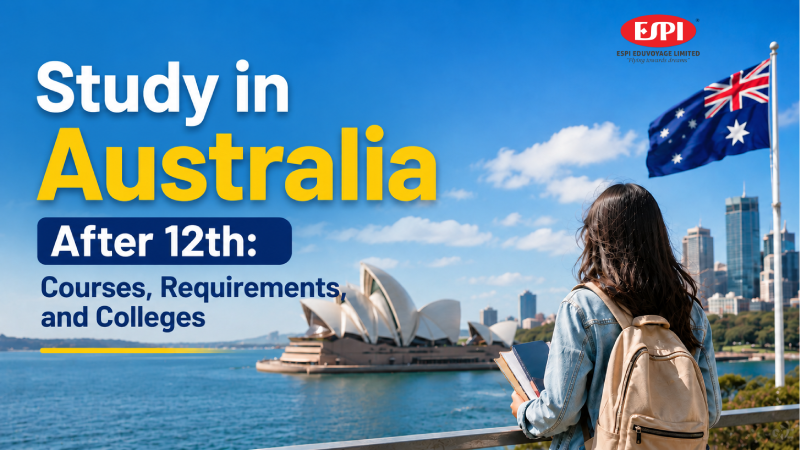
We at ESPI Visa Consultants have been guiding Gujarati students through this exact journey for years, and in this blog we are breaking down everything you need to know to Study in Australia right after your 12th — courses, requirements, top colleges, costs, and the small mistakes that cost students their visa.
Why Australia Is the Smart Pick After 12th
It was always considered to be dangerous to go to study in other countries immediately after completing studies. However, nowadays, it is the better option for many Indian students as Australian universities take marks obtained by Indian students in class 12, without requiring any special test and foundation year. In addition, classes at universities have a practical nature and include internship. In this way, graduates obtain a certificate and up to two years of work experience.
Also, it can be stated that Australia is a really safe country with a multi-cultural background, having a strong educational system with the focus on providing assistance to all students. There are large Indian and Gujurati communities in such cities as Melbourne, Sydney, Brisbane, Adelaide, and Perth. It is possible to get a Subclass 500 visa, according to which one is allowed to work up to 48 hours in two weeks in session time and work full time during breaks. In general, students manage to cover up to 60% of expenses using this option, which significantly reduces the family burden. Thus, the popularity of Australia Education Consultants in Gujarat increased dramatically over the last three years.
Courses You Can Pick After 12th
The course you choose right now decides your career for the next 10–15 years, so this part deserves real thought. After 12th, the most popular options are:
Bachelor of Business / Commerce — for students from commerce or those interested in finance, marketing, HR, and analytics. Duration is 3 years.
Bachelor of Engineering / Computer Science / IT — 4-year programmes with strong placement records. Cybersecurity, data science, and AI specialisations are booming right now.
Bachelor of Nursing / Health Sciences — Australia has a massive demand for nursing professionals, and the post-study work pathway is one of the strongest.
Bachelor of Hospitality and Tourism Management — practical course with paid internships built in. Great for students who do not want a traditional desk career.
Bachelor of Design / Architecture / Media — for creative students. Australia is a strong hub for design education.
Diploma + Bachelor (2+2 pathway) — for students whose 12th score is on the lower side. You start with a diploma at a partner college and move into the second year of a bachelor’s degree at the partner university.
Foundation Programmes — typically 8–12 months long, designed for students who do not directly meet university entry requirements.
There is no “best” course. The best course is the one that matches your interest, your academic strength, and your long-term career plan.
Eligibility and Requirements
Here is the honest checklist most blogs avoid spelling out:
Academic requirement: Class 12 with minimum 60% for most universities. Top Group of Eight universities ask for 70–80% depending on the programme. Maths is mandatory for engineering and certain commerce courses.
English proficiency: IELTS overall 6.0 to 6.5 (with no band below 5.5/6.0) is the typical cutoff. PTE Academic 50–58 is also widely accepted. Some universities accept Class 12 English marks for waivers.
Genuine Student (GS) Statement: This replaced the old GTE in 2024. It is a written statement explaining why you chose Australia, your course, and your post-study plan. The visa officer reads this carefully, so it has to be honest and well-structured.
Financial proof: You need to show funds covering one year of tuition + AUD 29,710 for living expenses (2025–26 figure) + travel costs. This can be through education loan sanction letters, fixed deposits, or family bank balance.
Other documents: Passport, statement of purpose, two LORs (some universities), updated CV (where applicable), and OSHC health insurance.
Top Colleges Worth Aiming For
Group of Eight (Go8) — Australia’s research-heavy elite group. University of Melbourne, University of Sydney, ANU, Monash University, UNSW Sydney, University of Queensland, University of Western Australia, and University of Adelaide. Strong global rankings, demanding entry requirements.
Highly ranked non-Go8 universities — Deakin, RMIT, Macquarie, UTS, Wollongong, La Trobe, Curtin, Griffith, and QUT. These often offer better scholarships and more practical, industry-linked programmes.
For diploma/pathway courses — Kaplan Business School, SAE Institute, Australian Catholic University pathways, and university-affiliated colleges like Trinity College (Melbourne), UNSW College, and Monash College.
If your 12th percentage is between 55% and 70%, do not get discouraged — there are excellent universities that accept this range with the right SOP and supporting profile. As experienced Australia Education Consultants in Gujarat, our team at ESPI Visa Consultants matches students with universities where their profile actually has a strong chance, not just where the brochure looks pretty.
What It Actually Costs
Tuition fees per year (rough 2026 estimates):
- Group of Eight universities: AUD 38,000 – AUD 50,000
- Mid-tier universities: AUD 28,000 – AUD 38,000
- Diploma/Pathway colleges: AUD 18,000 – AUD 28,000
Monthly living costs:
- Sydney, Melbourne: AUD 2,000 – AUD 2,500
- Brisbane, Perth, Adelaide: AUD 1,500 – AUD 2,000
- Smaller cities like Hobart, Wollongong: AUD 1,300 – AUD 1,800
Most students bring this number down significantly through shared accommodation, student concessions on public transport, and part-time work. Scholarships can knock 10% to 50% off your tuition — and many of them are profile-based, not just merit-based, so even average academic students can apply.
Why Choose Us
At ESPI Visa Consultants, we have built our reputation in Gujarat by being honest with students — even when the honest answer is “this course is not right for you.” Our counsellors have handled hundreds of post-12th Australia cases across cities like Vadodara, Ahmedabad, Surat, Anand, and Bharuch, and we know exactly how Australian admission committees and visa officers think.
From shortlisting the right university based on your real percentage and budget, to drafting a GS statement that passes visa scrutiny, arranging financial documentation, booking OSHC, applying for scholarships, and preparing you for the visa interview — every step is handled in-house with personal attention. As trusted Australia Education Consultants in Gujarat, ESPI Visa Consultants does not just process applications — we genuinely care whether you land in your dream campus or not, and that shows in every student we have placed so far.
Conclusion
Enrolling for higher studies in Australia immediately after completing 12th standard is perhaps the best decision that any student can make nowadays, provided that the planning and implementation process is well organized. Australia provides top universities, competitive admission procedures, flexible work-from-studies opportunities, great post-study options, and a diversified society where Indian students find it easy to adjust compared to other nations. What prevents you from studying in Australia is the appropriate guidance at the correct time. ESPI Visa Consultants will ensure that all the processes, from choosing the appropriate courses to applying for the visa, become systematic, transparent, and hassle-free for you.
Want to Study in Australia right after 12th with the right course, the right university, and a clean visa file? Talk to our experts at ESPI Visa Consultants today. Call +91 7211117272 or email enquiry@espiconsultants.com.
FAQs
Can I directly Study in Australia after 12th without any entrance exam?
Yes. Australian universities accept Class 12 marks directly. There is no separate national entrance exam — only IELTS/PTE for English proficiency and university-specific requirements.
What is the minimum 12th percentage required?
Most universities accept students with 60% and above. Group of Eight universities usually look for 70–80%. Students with lower scores can opt for diploma + bachelor pathways.
How much does it cost to study in Australia per year?
Tuition typically ranges between AUD 25,000 and AUD 50,000 per year. Monthly living expenses range from AUD 1,500 to AUD 2,500 depending on the city you choose.
Can I work part-time while studying in Australia?
Yes. International students can work up to 48 hours per fortnight during sessions and unlimited hours during semester breaks under the Subclass 500 student visa.
Why should I go through Australia Education Consultants in Gujarat instead of applying directly?
Because the GS statement, financial documentation, course-COE mapping, and visa file presentation need real expertise. A small mistake in any of these can lead to a rejection that takes months to recover from