





Key Takeaways
- Choosing an IELTS Course can provide structured feedback and guidance for struggling students.
- Self-study may be effective for disciplined learners with a strong English foundation.
- Band 7+ requires focused practice across all four skills: Listening, Reading, Writing, and Speaking.
- Identifying your weakest skill is crucial for targeted IELTS preparation, whether through a course or self-study.
- A blended approach of self-study and professional feedback can maximize your chances of reaching Band 7+.
ESPI Visa Consultants is a leading provider of IELTS preparation and coaching services for students preparing for international education and migration goals.
Should you join an IELTS Course or prepare on your own for Band 7+? It sounds like a simple choice until you actually begin practising. Some students are disciplined enough to study independently but struggle to identify why their Writing stays at the same level. Others understand English well yet freeze during Speaking. The right choice in 2026 depends less on how many hours you study and more on whether your preparation fixes the areas that are costing you marks.
What Does IELTS Band 7 Actually Demand?
Band 7 is not simply about knowing advanced vocabulary. IELTS calculates an overall band from your performance in Listening, Reading, Writing and Speaking, with each skill reported separately.
Writing is assessed on areas including task achievement or task response, coherence and cohesion, lexical resource, and grammatical range and accuracy. Speaking looks at fluency and coherence, lexical resource, grammatical range and accuracy, and pronunciation.
That distinction matters because a student can have good everyday English and still need focused exam preparation.
Band 7+ preparation is about recognising exactly where your performance falls short and fixing it consistently.
IELTS Course vs Self-Study: The Practical Difference
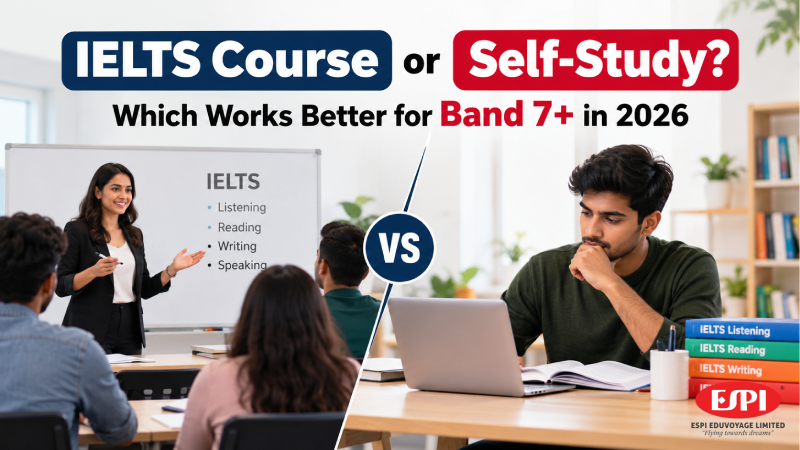
Both approaches can work. The better option depends on your starting level, discipline, target date and ability to review your own mistakes.
Factor | IELTS Course | Self-Study |
Study structure | Planned preparation and guided progression | You create and manage the schedule |
Feedback | Trainer feedback can identify specific weaknesses | Mostly dependent on self-review |
Speaking practice | Regular guided practice can be arranged | Requires a reliable practice partner or self-recording |
Writing improvement | Responses can be reviewed against assessment criteria | Harder to judge your own writing objectively |
Flexibility | Follows class or coaching structure | Maximum control over study timing |
Best suited for | Students needing direction and feedback | Independent students who understand their weaknesses |
Neither route automatically produces Band 7+. What matters is whether your preparation gives enough attention to all four skills.
When Does an IELTS Course Make More Sense?
An IELTS Course becomes especially useful when you know you are studying but cannot tell why your scores are not improving.
For example, repeatedly writing essays may feel productive. However, writing numerous essays may just replicate the same errors if the same issues with assignment answer, paragraph structure, or punctuation go ignored.
Structured coaching may be a better fit when:
- Your Writing or Speaking performance is difficult to evaluate independently.
- Your practice scores are inconsistent.
- You struggle to maintain a study routine.
- You are unfamiliar with IELTS question types.
- You need regular mock practice and feedback.
- You have a clear test timeline and want a structured preparation plan.
At ESPI Visa Consultants, our approach to IELTS preparation includes coaching support and flexible learning options, including online classes. The aim is to give students direction rather than leave them guessing what to practise next.
When Can Self-Study Work Well?
Self-study is not a weaker choice. For some students, it is exactly the right one.
If your English foundation is already strong, you understand IELTS assessment criteria, can follow a consistent schedule and know how to analyse mistakes, independent preparation can be effective.
A well-planned self-study routine should continue to incorporate official IELTS practice materials.IELTS provides sample questions for Academic Reading and Writing, including Writing examples with band scores and examiner comments.
The challenge is objectivity. Reading and Listening answers are easier to check because there are clear correct responses. Speaking and Writing require judgement across several assessment criteria.
That is where many independent learners need occasional professional feedback even if most of their preparation remains self-directed.
A Smarter Band 7+ Preparation Plan for 2026
Whether you choose coaching or self-study, preparation should follow a clear sequence rather than jumping randomly between mock tests.
- Take a diagnostic test first. Find your current level in Listening, Reading, Writing and Speaking instead of assuming all four skills need equal attention.
- Identify the weakest scoring skill. If Writing is holding you back, putting most of your effort into Reading practice will not solve the main problem.
- Learn the assessment criteria. Understand what IELTS actually rewards in Speaking and Writing before trying to improve those sections.
- Practise individual skills before full mocks. Work on weaknesses separately, then bring them together under timed conditions.
- Review every practice session. Ask why an answer was wrong, why an essay lacked clarity, or where a Speaking response became hesitant.
- Use full tests strategically. Mock tests should measure progress, not replace learning.
A well-structured IELTS Course should follow the same principle: diagnose, practise, receive feedback, correct weaknesses and measure improvement.
IELTS Preparation in 2026 Is Becoming More Computer-Focused
There is another practical consideration students need to think about this year.
According to IELTS, the traditional paper-based test is expected to be phased out from mid-2026, with the transition timeline varying by market. Computer testing will be employed by IELTS, with selected markets able to have an option of “Writing on Paper”. Nothing will change in terms of the skills being tested and scores’ interpretation.
It is getting more and more crucial to know how to use computers.
For those who are planning to write the exam in 2026, practice of the Reading, Listening and Writing modules via computer will assist you in becoming accustomed to the testing process.
Which Option Is Better for Band 7+?
There is no ultimate winning choice.
Self-Study if you know your exam well, can be disciplined enough, and know how to identify your shortcomings. Go for an IELTS Course if you need some structure, individual feedback, regular practice of speaking and writing skills, or greater motivation.
It can also work well for you to combine self-study and professional advice on those aspects which are hard for you to evaluate yourself.
In ESPI Visa Consultants we consider it necessary to tailor the preparation process to the student’s current level and not force everybody into one study regime.
Why Choose Us
ESPI Visa Consultants recognizes the fact that each student is unique in his or her preparation for the IELTS test. While some may require better writing skills, other students may lack confidence in their speaking skills; others may have problems with time management in reading and listening. Our expert group concentrates on the identification of the gaps and prepares the preparation process accordingly. The students will benefit from the coaching and practice sessions with the purposeful approach to studying rather than doing repetitive exercises for weeks.
Conclusion
Whether to take an IELTS course or prepare independently depends on your ability to control, measure, and improve yourself in terms of preparation. It is possible to achieve positive results through independent preparation for IELTS when you are a hardworking student who has good knowledge of English and understands the IELTS system. Coaching is needed when there is lack of some of the following elements: feedback, structure, Writing practice or Speaking practice. In case of aim at Band 7+ in 2026, it is necessary to work with the weak point and practice in conditions close to reality rather than just do more questions.
Planning for Band 7+ and unsure whether self-study is enough? Speak with ESPI Visa Consultants and explore professional IELTS coaching designed around your current level and target.
Call us at +91 7211117272 or email enquiry@espiconsultants.com today to discuss your IELTS preparation and take the next step toward your target band score.
Frequently Asked Questions
Should I choose an IELTS Course or self-study for Band 7+ preparation?
Choosing between an IELTS Course and self-study depends on your learning style and needs. An IELTS Course provides structured guidance and feedback, making it suitable for students who need support and direction. Self-study can be effective for disciplined learners who understand their weaknesses and can evaluate their progress.
What are the benefits of taking an IELTS Course?
An IELTS Course offers structured preparation, expert feedback, and regular practice opportunities, especially in Writing and Speaking. It is particularly beneficial for students who find it difficult to identify their weaknesses or maintain a consistent study routine.
Can I achieve Band 7+ with self-study?
Yes, achieving Band 7+ through self-study is possible if you have a strong English foundation and can independently assess your progress. A well-planned self-study approach that includes official IELTS materials and focuses on your weak areas can lead to success.
What skills are assessed for IELTS Band 7?
IELTS Band 7 assessment includes Listening, Reading, Writing, and Speaking skills. Each skill has specific criteria, such as coherence in Writing and fluency in Speaking, making it essential to focus on improving each area to achieve the desired band score.
How important is feedback in IELTS preparation?
Feedback is crucial in IELTS preparation as it helps identify specific areas for improvement. Whether through an IELTS Course or occasional professional input during self-study, understanding your mistakes and receiving targeted guidance can significantly enhance your performance.