





Key Takeaways
- Canada hosts more than 4 lakh Indian students, making it the largest Indian student population in any country in the world — clear proof of how strong the system is for Indian aspirants.
- Tuition costs at Canadian universities range between CAD 15,000 and CAD 40,000 per year, while community colleges and DLI-approved diploma programmes offer significantly more affordable routes starting at around CAD 12,000.
- The Post-Graduation Work Permit (PGWP) gives international students up to 3 years of open work rights after graduation, which is one of the clearest pathways to Permanent Residency in the world.
- Canada has three main intakes — Fall (September), Winter (January), and Summer (May) — giving students multiple application windows across the year.
- The SDS (Study Direct Stream) visa route, available exclusively for Indian students, offers faster processing when paired with a GIC, IELTS 6.0+, and a DLI offer letter.
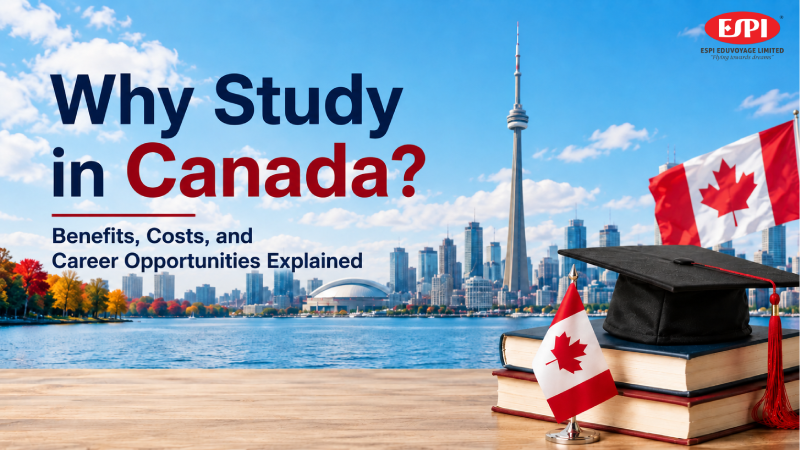
snow falling outside your window in Toronto while you finish an assignment, a part-time café job that pays in Canadian dollars, classmates from twenty different countries, and a clear pathway to permanent residency at the end of it. For nearly half a million Indian students, this is not a fantasy — it is the everyday reality of studying in Canada.
Canada has slowly turned into the most preferred international study destination for Indian students, overtaking the US in sheer numbers. The reasons are not random. Genuine post-study work rights, multicultural cities, world-recognised universities, transparent visa rules, and one of the smoothest student-to-PR pipelines anywhere in the world — Canada simply gets it right.
But the catch is that not every aspirant lands there successfully. Visa rejection rates climbed in 2024 due to weak SOPs, mismatched financial documents, and rushed applications. So the country is welcoming, yes — but only when the application is built properly. We at ESPI Visa Consultants have helped hundreds of Gujarati students navigate this exact journey, and in this blog we are walking you through every real reason to Study in Canada, what it costs, and the kind of careers you can actually build there.
Why Canada Tops the List for Indian Students
Officially, Indian students account for almost 40 percent of the total number of international students in Canada. It’s not a sales pitch; it’s simply the largest Indian diaspora in the world. And there’s no secret behind that statement.
Canadian universities rank among the best in the world, with reputable institutions such as the University of Toronto, McGill, UBC, Waterloo, McMaster, and Queen’s holding their own against institutions worldwide in the top 200 universities ranking. The academic environment is research-oriented, multicultural, and based on industry needs, and that is the reason why students from Canadian universities boast the highest placement rate in North America.
In addition to that, cities such as Toronto, Vancouver, Montreal, Calgary, and Ottawa have large Indian populations, vegetarian restaurants, gurudwaras, temples, and Gujarati organizations, making the transition much smoother than in some other countries. That is precisely why students and their families consult Canada Education Consultants in Vadodara first.
Real Benefits of Studying in Canada
Affordable compared to the US and UK. A four-year bachelor’s in Canada often costs 30–40% less than an equivalent US programme. Community college diplomas can come in even cheaper.
Strong post-study work rights. The PGWP gives you up to 3 years of open work permit — meaning you can work for any employer, in any sector, anywhere in Canada. Few countries offer this kind of flexibility.
Pathway to PR. This is the real gamechanger. After working full-time for around 1 year on a PGWP, most students become eligible to apply for Permanent Residency through Express Entry, the Canadian Experience Class, or one of the Provincial Nominee Programs (PNP). Few other countries have such a clean path from student visa to PR.
Healthcare and quality of life. Most provinces provide subsidised or free healthcare to international students. Canadian cities consistently feature among the world’s most liveable cities — Vancouver, Toronto, Calgary, Ottawa.
Part-time work. Students can work up to 24 hours per week off-campus during sessions and full-time during scheduled breaks, helping cover a major chunk of living expenses.
What It Actually Costs
Here are realistic 2026 estimates so you can plan honestly.
Tuition (per year):
- Top universities: CAD 30,000 – CAD 50,000
- Mid-tier universities: CAD 18,000 – CAD 30,000
- Public colleges (diplomas, PG diplomas): CAD 14,000 – CAD 22,000
Living costs (per month):
- Toronto, Vancouver: CAD 1,500 – CAD 2,000
- Montreal, Calgary, Ottawa: CAD 1,200 – CAD 1,600
- Smaller cities like Winnipeg, Saskatoon, Halifax: CAD 1,000 – CAD 1,300
Visa-related financial proof:
- GIC of CAD 20,635 (mandatory for SDS)
- First-year tuition fee paid upfront (for SDS)
Other one-time costs:
- IRCC visa fee: CAD 150
- Biometrics: CAD 85
- Health insurance and travel costs: CAD 1,500–2,500
Most students bring their effective costs down by working part-time, choosing shared accommodation, and applying for in-house scholarships. Canadian universities and colleges actively offer entrance scholarships ranging from CAD 1,000 to full-tuition waivers, especially for academically strong applicants.
Top Universities and Colleges Worth Targeting
Top Universities (research-driven): University of Toronto, University of British Columbia, McGill University, University of Waterloo, McMaster University, Queen’s University, University of Alberta, University of Calgary, Western University, University of Ottawa, Dalhousie, Simon Fraser.
Strong Public Colleges (career-focused, diploma + PG diploma): Seneca College, Centennial College, George Brown College, Humber College, Sheridan College, Conestoga College, Algonquin College, Fanshawe College, Niagara College, Douglas College, BCIT.
Best for tech and engineering: University of Waterloo, University of Toronto, UBC, McGill, Queen’s, Conestoga (for diplomas).
Best for business and finance: Rotman (Toronto), Schulich (York), Ivey (Western), Smith (Queen’s), Sauder (UBC), Desautels (McGill).
Best for healthcare and nursing: McMaster, Dalhousie, University of Alberta, University of Calgary, Mohawk College.
The right choice depends on your academic profile, budget, and PR strategy. As experienced Canada Education Consultants in Vadodara, we at ESPI Visa Consultants match students based on real-fit logic — not glossy brochures.
Career Opportunities After You Graduate
This is where Canada truly differentiates itself from other study abroad countries.
Canada’s employment sector in 2026 has a shortfall of workers in areas such as technology, health care, skilled trades, logistics, finance, and education – fields that have been known to actively recruit foreign graduates. Thanks to the Post-Grad Work Permit, you are free to take on any job within Canada for at least a year before applying for Permanent Residency.
Average starting salaries for Indian graduates:
- Tech roles (software, data, cybersecurity): CAD 55,000 – CAD 80,000
- Business and finance entry roles: CAD 45,000 – CAD 65,000
- Engineering: CAD 55,000 – CAD 75,000
- Healthcare support and nursing: CAD 50,000 – CAD 70,000
- Skilled trades: CAD 50,000 – CAD 90,000
PR pathways:
- Express Entry – Canadian Experience Class (CEC) — for graduates with at least 1 year of skilled work experience.
- Provincial Nominee Program (PNP) — provinces like Ontario, BC, Alberta, Manitoba, and Saskatchewan have dedicated streams for international graduates.
- Quebec Experience Program (PEQ) — for graduates from Quebec institutions.
This is the part most students underestimate at the application stage. Choosing the right province and the right course directly impacts your PR chances 3–4 years down the line.
Why Choose Us
At ESPI Visa Consultants, our Canada counselling desk is one of the busiest in our office for a reason — we genuinely understand how the Canadian system works, from DLI lists and SDS rules to PNP-aligned course selection. Our team has handled hundreds of Canada cases for students across Vadodara, Ahmedabad, Surat, and Anand, and we treat every file like it is the only one we are working on. We sit with each student personally to map their academic background, budget, and PR goal to the right province, the right institution, and the right course — not just the most popular one. From SOP drafting to GIC setup, tuition payment coordination, IELTS planning, biometrics scheduling, and pre-departure briefing, the entire journey is handled in-house. As trusted Canada Education Consultants in Vadodara, ESPI Visa Consultants is the partner that genuinely cares whether you build a real future in Canada or not.
Conclusion
To pursue studies in Canada in 2026 happens to be one of the most comprehensive decisions that an Indian student can take, both in academic as well as financial and career terms. From globally recognized universities, clear-cut visa process, lucrative post-study work permits, to one of the easiest pathways from being a student to gaining permanent residency in the whole world, studying in Canada offers everything you need to succeed. The only determining factor for turning your dream to study in Canada into reality will depend on the quality of advice you get in the beginning. With ESPI Visa Consultants guiding you through the whole process, things will become easier for you.
Want to Study in Canada in 2026 with the right course, the right province, and a clean visa file? Talk to our experts at ESPI Visa Consultants today. Call +91 7211117272 or email enquiry@espiconsultants.com.
FAQs
How long does it take to get a Canadian student visa?
SDS applications are usually processed within 4 to 6 weeks. Non-SDS applications can take 8 to 12 weeks depending on workload at the visa office.
Do I need IELTS to Study in Canada?
For the SDS route, an overall IELTS score of 6.0 with no band below 6.0 is required. PTE Academic 60 is also accepted under the updated SDS guidelines.
Can I bring my spouse with me on a student visa?
Spouses of master’s, PhD, and certain professional programme students can apply for an open work permit. For undergraduate and most college diploma students, spousal open work permits are currently restricted.
How much money do I need to show as proof of funds?
You must show CAD 20,635 as a GIC for living expenses, plus your first-year tuition fee paid upfront for the SDS route. Additional travel and incidental funds also help strengthen the file.
Can I apply for PR after I finish my studies?
Yes. After completing your eligible programme, you can apply for the PGWP and use that work experience to apply for PR through Express Entry or a Provincial Nominee Program.